


Turn individual AI experiments into
more consistent team practices.
Give employees a practical way to use approved tools, check their work and recognize the limits. Pair training with clear responsibilities and a manageable improvement plan.
Training should connect to
work people actually do.
A useful session starts with roles, tasks and approved examples. A salesperson preparing a follow-up, an account manager reviewing an inquiry and a content editor checking technical language have different needs.
We define the audience and intended outcomes before choosing the exercises. Generic prompting tips are not a substitute for a shared process.
 Salesperson
 Preparing a follow-upAccount manager
 Reviewing an inquiryContent editor
 Checking technical language
Three training formats.

Leadership workshop
Identify useful opportunities, separate capacity benefits from cash savings, and decide which work needs deeper assessment.

Role-based team workshop
Practice a small number of approved tasks, examine weak outputs, verify information and document reusable steps.

Adoption working session
Review what employees are actually using, what is slowing them down and which requests belong in a future improvement plan.
Practical materials your team can use afterward.
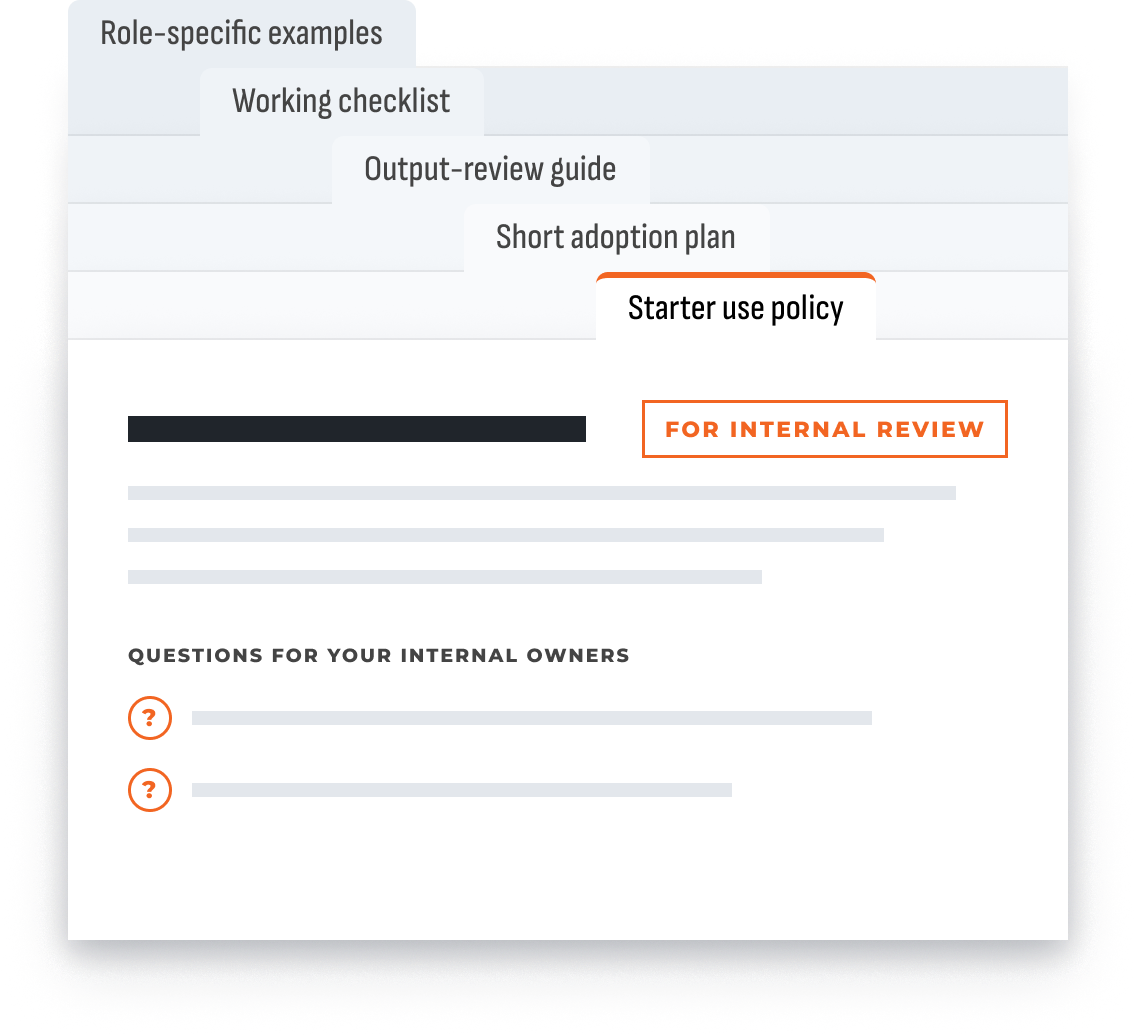
An agreed session can include role-specific examples, a working checklist, an output-review guide, a starter use policy for internal review and a short adoption plan. We confirm the participant count, delivery format, materials and follow-up before quoting.
Policy materials support your internal discussion. They are not a legal opinion, a security certification or a substitute for review by your responsible advisors.
Ongoing guidance without an
open-ended commitment.
An ongoing plan can include scheduled leadership check-ins, office hours, review of proposed use cases, adoption tracking and a prioritized backlog. The agreement defines the cadence, participants, available hours and response arrangements.
AN ONGOING PLAN CAN INCLUDE
 Scheduled leadership check-ins
 Office hours
 Review of proposed use cases
 Adoption
tracking
 A
prioritized backlog
THE AGREEMENT DEFINES
 Cadence
 Participants
 Available
hours
 Response arrangements
Guidance is different from operating a production application. System monitoring, incidents, integration maintenance and new development are included only when a separate managed-service scope says so.
Know whether the training made a
difference.
Use a relevant before-and-after exercise, employee feedback and a follow-up review of the actual task. Look for sound judgment, consistent use of approved information and less rework, not just attendance or the number of prompts entered.
 Before-and-after exercise
 Employee feedbackFollow-up review of the actual task
LOOK FOR
NOT JUST
Start with one team and a small set of useful practices.
Expand when the people responsible for the work see the benefit.
Questions you may have.
Explore the next step.
Start with the work
worth improving.
Describe the challenge. We will help identify a practical next step.
Discuss Team Training