

Most marketing teams we talk to are stuck in one of two places.
They have not really integrated AI at all. They have ChatGPT subscriptions, ask their team to use them, and assume it's being leveraged for their benefit.
They have bought too many tools, have not figured out which ones are earning their keep, and are starting to feel quietly embarrassed about the budget line.
Both groups are about to be passed by competitors doing the hard, unglamorous integration work right now.
There is no one-size-fits-all, but the following is a stack we see benefiting our clients so far in 2026.
Research and Competitive Intelligence
This is the layer where the gains are biggest, the cost is lowest, and the adoption curve is fastest. Done well, it changes how an industrial marketing team thinks. Done poorly, it produces confidently wrong briefings that nobody catches because the language model sounds authoritative.
The tools here are the major-player LLMs accessed through their consumer interfaces: ChatGPT, Claude, Gemini, and Perplexity. ChatGPT and Claude are stronger on long-form synthesis; Perplexity on real-time research with citations; Gemini integrates cleanly with Google Workspace.
The gain comes from compressing work that took days into hours. Treat the LLM as a fast, well-read junior analyst who must be fact-checked, never as the final authority.
 Competitive intelligence
First-Draft Content Production
This is where AI hype originally landed in 2023 and where most teams overcorrected by either over-trusting AI output or banning it outright. By mid-2026, the practical answer is somewhere between the two.
AI is excellent at first drafts, variant generation, and adaptation work. It is not excellent at producing publishable, voice-consistent, factually accurate, strategically aligned final-form content without a meaningful human editing layer. For industrial B2B, the human editing layer is where credibility lives — your buyers are technical, skeptical, and quick to notice when copy is generic or claims are unsupported.
Define the goal
Clarity on the intended outcome and the roadmap to get there.
Co-create with AI
Detailed prompts with brand voice, audience, and supporting research.
Human editing
Editing and perfecting so the final product is genuinely high quality.
The AI piece compresses what used to be a five-day timeline into roughly two days. The human pieces are what make it publishable.
Visual, Video, and Voice Production
 Visual & voice
This layer matured fast over the last twelve months and is now genuinely useful for industrial B2B at production scale. For static images, the leading models — Midjourney, Flux, Adobe Firefly, OpenAI's image generation, and Google's Imagen — have crossed the credibility threshold for marketing illustration and stock-image replacement. Industrial photography of actual products still belongs with a real photographer.
For video, Runway, Google Veo, and OpenAI's Sora have reached usable quality for short-form social and B-roll, though realistic product video still needs a real production workflow.
The category we have found most useful is AI avatar and voice production. HeyGen and ElevenLabs are now mature enough to support training videos, multilingual versions, and product walkthrough narration at a fraction of the cost of traditional studio production.
- Always disclose AI use where it would affect viewer trust.
- Always have someone with editorial judgment in the loop.
- Always be ready to defend the choice, because your buyers will ask.
CRM and Marketing Automation
This is the layer where AI moves from "useful tool" to "embedded in the operating system." Both HubSpot Breeze and Salesforce Agentforce / Einstein crossed into production scale during late 2025 and early 2026, and the right choice depends on which CRM your operation lives in and how much customization you need.
Short deployment, moderate depth
Embedded across every Hub and available on every tier, including the free CRM. Includes Breeze Copilot, Breeze Agents, and Breeze Intelligence. Reportedly the first major CRM to ship a production-grade MCP server. For most mid-market industrial firms on HubSpot, this is the right answer.
Deeper power, higher discipline
The more powerful option if you live in Salesforce. Public reporting indicates roughly 18,500 customers and over three billion monthly workflows by early 2026. Setup cost and ongoing customization are meaningfully higher. For larger firms with dedicated administration, often the right answer.
The honest assessment is that the capability gap between Breeze and Agentforce is narrower than the marketing of either platform suggests. Do not switch CRMs to get AI; the switching cost will dwarf the AI gain.
Companies using CRM systems with generative AI features were reported to be substantially more likely to exceed quota. Teams with disciplined data hygiene get most of the gain; teams that bolt AI onto a messy CRM get less, sometimes nothing.
Search Visibility & AEO / GEO Measurement
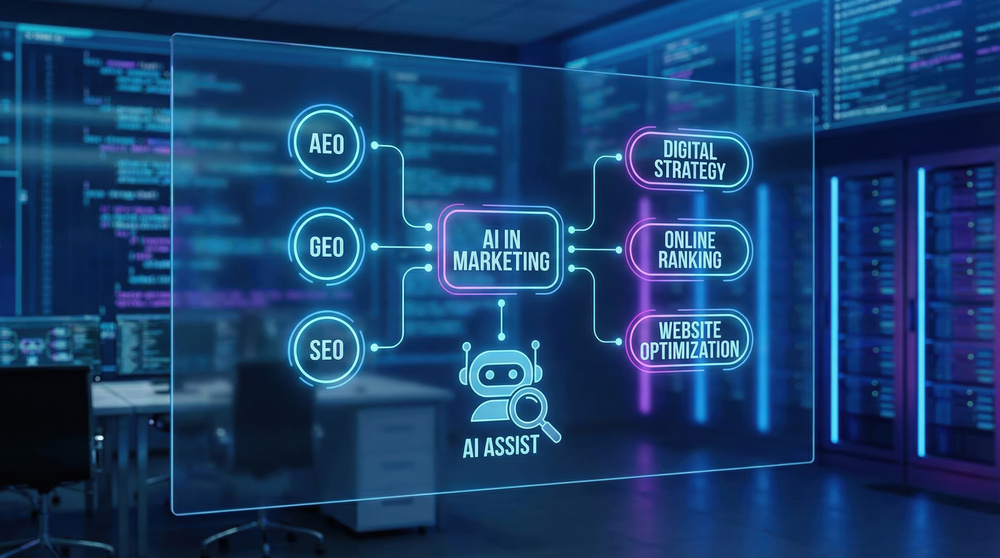
These tools measure your visibility in AI answer engines, track competitive share of voice, identify the third-party sources AI systems are citing in your category, and provide the executive-grade reporting that traditional analytics no longer cover on their own.
This layer is non-optional for industrial firms that take AEO and GEO seriously. The right tier depends on the size of your prompt set and the depth of the source-attribution work you need.
 AEO / GEO measurement
PPC, Ads, and Performance Channels
 Performance channels
The Google Ads ecosystem moved decisively into AI-managed bidding and creative optimization. Performance Max, Demand Gen, and AI-generated creative now make up most of where industrial PPC budgets flow. Meta's Advantage+ has done the same on the social side, and LinkedIn's Predictive Audiences are catching up.
The algorithms are better than most human managers at optimization, but they are only as good as the conversion data and audience signals you feed them. We have seen industrial clients move to AI-managed campaigns and either roughly double their efficiency or roughly halve it, depending entirely on the quality of the data layer underneath.
This is one of the places we recommend pairing a human PPC specialist with AI-managed campaign infrastructure. The specialist's job has shifted from manual bid management to data quality, feed engineering, and exception handling. The role is more strategic, not eliminated.
Workflow Orchestration & Internal Agents
This is the newest layer and the one most companies are not paying enough attention to. Workflow orchestration platforms let you chain models, tools, and data sources to do specific marketing operations work without writing code.
The skill that matters here is operational design, not coding. The teams that get value have someone who can break a recurring workflow into discrete steps an orchestration platform can execute, and then maintain it as things change. The maintenance cost is real. The leverage is also real.
Our Amplify Analyze work increasingly lives at this layer for our clients, because it is where unique competitive advantage gets built when most of the rest of the stack is becoming commoditized.
 Orchestration
- Automatic intake of inbound leads from multiple sources into HubSpot with AI-driven enrichment and routing.
- Automated competitive monitoring that flags significant changes on competitor sites and produces weekly briefings.
- Content repurposing pipelines that turn a single pillar piece into formats for LinkedIn, email, and the blog.
- Automated quarterly reports pulling from GA4, GSC, HubSpot, the AEO layer, and the CRM into one executive deck.
What's Mostly Hype Right Now
These posts would not be honest without naming what is not working as well as the marketing suggests.
Fully autonomous marketing agents
Agents work well for narrow, well-defined, repeatable tasks. They do not yet run a marketing department. Plan around humans who use agents, not agents that replace humans.
Pure AI SEO content factories
Producing 500 blog posts a week with AI is now a credibility-destroying mistake for any serious B2B brand. The companies who built organic strategies on AI-spam are spending a lot to undo it.
One-tool-to-rule-them-all platforms
Several vendors pitch a single AI platform that replaces everything. None we have evaluated actually do. The right stack remains modular.
AI sales agents that book meetings
These work in narrow B2C and high-volume SDR motions. They do not yet work in considered industrial B2B sales where the buyer expects to talk to someone who understands their application.
The Governance Layer Most Teams Skip
The work that separates teams who use AI well from teams who get into trouble with it is governance — not in a corporate compliance sense, but in a practical "did we agree on how this gets used" sense.
A usable policy covers which tools the team may use on which work; what client data may go into which tools; how AI-generated content is reviewed and approved; how AI use is disclosed where it matters; and how the team is trained and held accountable. It is not a long document. It is also not optional.
Make it short. Make it clear. Update it twice a year. Train against it. The policy is not the protection — the training and the culture around it are.
Where to Start If You Are Behind
If you are concluding that your operation is behind, the recovery sequence is pretty direct.
- Write your AI usage policyRun a working session to agree on what tools you use for what work.
- Take inventory and cancel the dead weightFind what you are paying for that nobody uses. You will probably find at least one.
- Instrument one workflow per layerPick one in research, content, visual/video, and CRM. Document the before-and-after.
- Add the visibility measurement layerThis is where the work in Layers One through Four starts to compound into a monthly executive story.
- Begin the orchestration workThis is where durable competitive advantage gets built — and it requires a real internal commitment.
This is roughly the sequence we walk industrial clients through in our AI Consulting + Integration work. It is not flashy, but it produces a marketing operation that performs measurably better than one that just bought a lot of subscriptions.
The work is not a single project. It is a multi-quarter program with real budgets, real organizational change, and real returns. The companies that got serious in early 2024 are now visibly different from their competitors. The ones who get serious in 2026 still have a window. We believe those who wait until 2027 will find the window has closed.
If any of this resonates and you want to think through what an AI-enabled marketing operation should look like for your business, we are happy to start that conversation.