

Most of our posts are about your buyer as a human, with a screen, asking questions of AI.
We touch on SEO, AEO, and GEO as three distinct channels, and about how to measure visibility when the buying process moves into answer engines that you cannot see.
This post is about something different.
It is about your buyer when there is no human looking at a screen at all.
When the entity placing the query, comparing the suppliers, generating the RFQ, and routing the requisition is an autonomous or semiautonomous AI agent.
That is not a 2030 conversation.
Coupa launched its Navi agents into production in November 2025. Zip, SAP Ariba, Ivalua, Levelpath, Tropic, and Omnea all shipped agentic capabilities in the months that followed. The Universal Commerce Protocol added Amazon, Meta, Microsoft, Salesforce, and Stripe to its Tech Council on April 24, 2026. Adobe Commerce committed to supporting both UCP and the Agentic Commerce Protocol back in February.
Basically, the plumbing for agent-to-business commerce is being laid this year, with the consumer side first and B2B following on a measurable lag.
For industrial manufacturers and distributors, the question is not whether this happens. It is whether you will be discoverable, quotable, and procurable when it does. The companies getting it right in the next 12 to 18 months will be doing fairly unglamorous work: closing the SKU coverage gap, fixing product data, and making their information machine-readable.
The companies that wait will spend the next decade catching up.
Three Discoverability Problems, Not One
There is a tendency to treat “AI visibility” as one thing. It is not. For industrial B2B, there are three distinct discoverability problems that overlap but require different responses.
The part we have already covered. Buyers researching inside ChatGPT, Perplexity, Google’s AI Mode, and Microsoft Copilot need to encounter your brand, with accurate information, when they ask category-defining questions. That is AEO and GEO work.
A newer, more procedural problem. When a sourcing manager inside Coupa, Zip, SAP Ariba, or Levelpath asks the platform’s AI agent to find suppliers for a category, the agent draws on internal records, third-party feeds, and supplier networks like Coupa’s $9.5 trillion community spend dataset or SAP Ariba’s network of millions of vendors. Not represented well? You are not in the consideration set. Period.
The emerging layer. UCP, the Agentic Commerce Protocol, and the Agent Payments Protocol define how AI agents will eventually transact directly with businesses, without a human in the middle. The consumer side is first — Etsy and Wayfair are live, Shopify, Target, and Walmart are next. The B2B foundation is the same: structured, machine-readable product, pricing, and availability data over standard protocols.
All three problems benefit from the same underlying work. None of them are solved by what most industrial websites publish today.

Why B2B Is Not B2C Agentic Commerce
A lot of the agentic commerce coverage assumes B2C behavior:
In B2B, particularly industrial B2B, that workflow does not reflect reality. OroCommerce has written sharply about this and the structural differences are worth naming, because they shape what your discoverability work actually needs to deliver.
Contracts over catalogs
Industrial pricing is negotiated annually, often tied to volume commitments, payment terms, service-level agreements, and rebate structures. An agent asked to “find me 500 of part number X” is not comparing public list prices. It is referencing a contracted price within an approved supplier relationship. The agent’s job is execution within established commercial terms, not open-market sourcing.
Approval chains over instant checkout
A $50,000 component purchase routes through procurement, finance, and often engineering before execution. Most B2B agents are designed with human-in-the-loop checkpoints by default, not against them.
EDI over shopping carts
B2B has had transactional automation for forty years. The question for agentic procurement is not whether to introduce automation. It is whether to extend or replace existing EDI-based reorder flows. Agents are most useful at the seams where EDI breaks down: exceptions, substitutions, new vendor onboarding, and RFQ generation for non-routine purchases.
Approved supplier lists
Industrial buyers do not run open market sourcing on the bulk of their spend. They source against an approved supplier list that took years to build, vet, qualify, and contract. Getting onto that list is a months-to-years process. Getting noticed by the agent operating inside an existing approved supplier list is a different problem from getting noticed by an agent helping a buyer explore the open market for a new category.
What all of this means in practice: the agent’s job in B2B is much less “buy the thing autonomously” and much more “find the right thing, compare against approved suppliers, generate a draft RFQ, route for approval, and log the audit trail.” The discoverability work needs to support agents doing those jobs, not agents doing one-click checkout.
The Three Layers Where Industrial Buyers Encounter Agents Today
The engineer’s research, before the buying group ever forms
This is the Octopart and McMaster-Carr behavior pattern that has been quietly reshaping industrial discovery for years, and that has now extended into ChatGPT and Perplexity. Engineers and applications specialists ask AI systems for component recommendations, specification interpretations, and supplier comparisons before they open Google. By the time anyone in the formal buying group is searching for vendors, the shortlist has been formed. We covered this in Preparing for the AI Search Shift, and the dynamic is now intensified.
The procurement agent inside the buyer’s stack
Coupa Navi, Zip’s intake orchestration, SAP Ariba’s AI-native rebuild, Levelpath’s agent framework, Ivalua’s autonomous sourcing, Tropic’s procurement intelligence. Each of these platforms now ships AI agents that do supplier discovery via natural language, contract analysis, RFQ generation, bid comparison, and approval routing. Coupa’s announcement of Navi Supplier Discovery Agent in November 2025 explicitly called out natural language supplier discovery as a flagship capability. The agent is asking “find me suppliers of stainless steel valves rated for high-pressure cryogenic service, located in the U.S. Midwest, with ISO 9001 certification” and getting back a ranked list. Your firm is on that list or it is not.
Standards-based agent-to-business commerce
Universal Commerce Protocol, Agentic Commerce Protocol, and related standards (built on REST, JSON-RPC, MCP, and A2A) are being adopted by the major platforms throughout 2026. The April 2026 UCP Tech Council expansion to include Amazon, Meta, Microsoft, Salesforce, and Stripe was a meaningful signal. Adobe Commerce has publicly committed to UCP and ACP. The consumer use case will dominate the early implementations. The B2B equivalent, which will probably look more like “agent-assisted requisition and quote” than “agent-driven autonomous checkout,” is on the same roadmap a year or two behind.
If you are an industrial manufacturer or distributor in May 2026, layers one and two are already in production at scale. Layer three is the future you should be reading the roadmaps for. None of them are theoretical anymore.
The SKU Coverage Gap: The Single Biggest Industrial Marketing Liability of 2026
Here is the data point that should land hard for any manufacturer reading this.
According to industry research summarized by digitalapplied, most industrial manufacturers publish content on only 30 to 50 percent of their SKUs. The long-tail SKUs — the ones with lower individual volume but cumulatively meaningful revenue — often have a spec sheet PDF, a product family page, and not much else.
In a Google-first world, that was an acceptable tradeoff. The high-volume SKUs got the marketing attention, the long tail got found by part number search, and traffic flowed where it needed to flow.
In an AI-first world, that tradeoff is now a liability. AI systems generate answers about your products based on what they can read about your products.
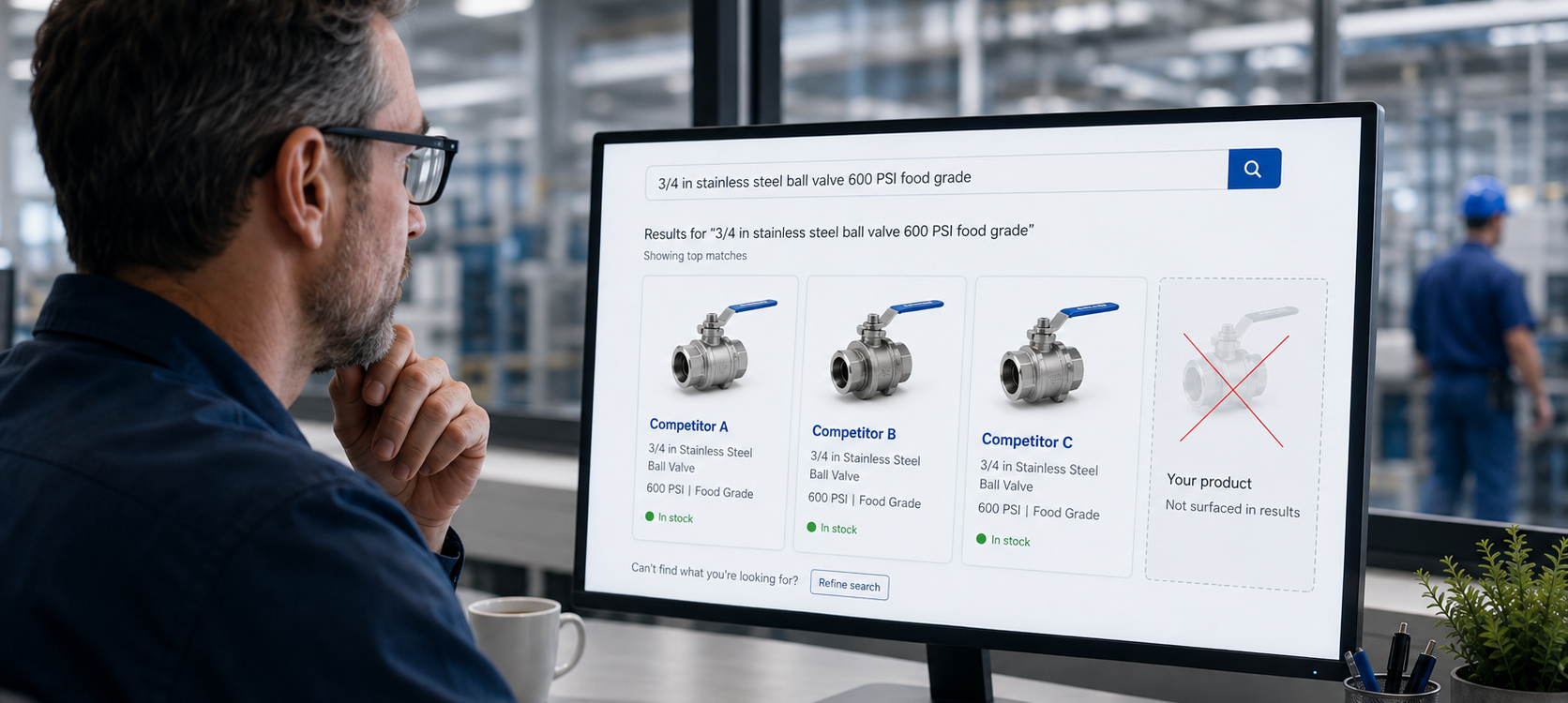
If a buyer’s agent asks “find me a 3/4-inch stainless steel ball valve rated for 600 PSI service in food-grade applications,” and you make exactly that valve but have never published structured application content about it, the answer the agent generates will not include you. It will include the competitor who did publish.
This is not a marketing problem. It is a revenue problem with a marketing solution. Closing the SKU coverage gap is the single highest-leverage work most industrial manufacturers can do in 2026.
What Machine-Readable Product Content Actually Looks Like
For the parts of your product portfolio that matter most, “machine-readable” means more than having a PDF on the website. The full picture, in plain English:
- Complete, structured specificationsEvery spec a buyer or an agent might filter on, exposed as structured data on the page itself — not buried inside a downloaded PDF that an agent has to OCR. Materials, dimensions, ratings, certifications, environmental tolerances, compliance markings, country of origin, lead times, and minimum order quantities.
- Consistent product identifiersManufacturer part number, GTIN/UPC where applicable, ECLASS classification code, UNSPSC code, and any industry-specific identifiers — HTS codes for cross-border, RoHS and REACH markings for compliance-sensitive components. These are the lookup keys agents use to disambiguate your product from a similar one made by someone else.
- Schema.org Product markupThe semantic markup that explicitly tells crawlers and AI systems “this is a product, here is its name, here is its identifier, here is its specification set.” Schema is one of the cheapest, highest-leverage investments in machine-readability and most industrial sites underuse it.
- Application-aware contextThe agent is not just matching specs. It is matching specs to use cases. A page that says “3/4-inch ball valve, 316 SS, 600 PSI” is matchable on specs but invisible on application queries. A page that adds “commonly specified for dairy and beverage CIP systems, FDA-compliant elastomers available, sanitary tri-clamp ends” is matchable on both. The application context is what makes the product appear in answers to natural-language questions, not just in structured spec searches.
- Accessible PDFsThis is where this post connects to the earlier one on web accessibility in 2026. A scanned-image PDF of a 1992 spec sheet is unreadable to a screen reader and unreadable to an AI agent. The same work that makes your technical documentation accessible to a person with a disability also makes it accessible to the agent acting on a buyer’s behalf. Pay once, win twice.
- CAD models and STEP filesFor components where engineers will design you in, providing CAD models is a buying-cycle accelerator. It is also a credibility signal to AI systems evaluating whether your firm is a serious vendor in a given category. Octopart, GrabCAD, and similar platforms have built much of their authority by aggregating exactly this kind of data.
- Clean PIM data flowing to channel partnersThe product data your distributor has on their site is often a worse, older, less complete copy of what is on your site. Agents querying your distributor will pick up that worse copy. PIM-driven syndication that pushes complete, current product data to your channel partners closes a hole that most manufacturers do not realize they have.
A Quick Note About Channel and Distributor Dynamics
A lot of industrial manufacturers sell exclusively or primarily through distribution. The agentic procurement layer changes the channel plan in some ways.
The distributor’s site is where most of the agent-mediated discovery is happening today. Coupa, Zip, and SAP Ariba all integrate more directly with distributor catalogs than with manufacturer sites. The data quality on those distributor catalogs is, in most categories, materially worse than the data quality on the manufacturer’s own site. The agent does not know that and will quote against the worse data.
A few practical implications. First, channel content strategy is now a discoverability strategy, not just a partnership strategy. Push your full product data to your distributors, monitor what they publish, and treat it as your storefront, not theirs. Second, your direct website still matters even for indirect sales, because the agent doing high-level supplier discovery (Coupa Navi, Ariba Navigator, etc.) is reading your site first to decide whether you belong on the shortlist before drilling into distributor inventory and pricing. Third, MAP policy, syndication agreements, and channel governance need an update to address agent-mediated queries that did not exist when those policies were drafted.
There is a parallel point about industry-specific supplier discovery platforms. The major search engines and the general-purpose LLMs are decent at industrial discovery but not great (as of this post). Some of the worst hallucinations we have seen in citation tracking have been on industrial categories where the underlying corpus is thin. This is part of the reason platforms like Octopart for electronics, GlobalSpec for general industrial, and emerging specialized platforms like our own Industrial Web Search exist. The agents will eventually integrate with multiple supplier discovery sources, and being well-represented across the specialized industrial platforms is part of the discoverability stack, not separate from it.
What to Do in the Next Six Months
For most industrial manufacturers and distributors, a realistic 180-day plan looks something like this.
- SKU coverage auditPull your full SKU master. Run a script or a vendor against your sitemap to identify which SKUs have meaningful published content — a page with structured specs, application context, and supporting documentation — and which have less. Quantify the coverage gap. Most manufacturers find it is worse than they expected.
- Data hygiene and identifier disciplineGet manufacturer part numbers, GTIN/UPC, ECLASS, UNSPSC, and applicable certification codes consistently populated in your PIM. Audit how this data flows to your website, your distributors, and any directories you participate in. Fix the breaks.
- Application-aware content for top SKUsPrioritize your top 100 to 500 SKUs by revenue or strategic importance. For each, ensure a published page with full structured specs (with Schema.org Product markup), accessible PDF documentation, application context, and where appropriate, downloadable CAD/STEP files. This is meaningful work and you will want clear ownership and a content engineering capability that can deliver at SKU scale.
- External authority and channel pushOnce your own house is in order, push enriched product data to distributors via syndication, confirm presence in the major industrial directories and supplier networks, and begin the earned-media work that builds external authority signals. The agents are reading both your site and the third-party sources that talk about your category.
Six months is fast. It also reflects what manufacturers actually have the capacity to do in 2026 between the day jobs of running marketing, supporting sales, and shipping product. The companies that get through this plan will be visibly different to AI systems by the end of 2026, in ways that compound into 2027.

Where This Connects to Everything Else
We have written about AI’s exponential trajectory and what the next 24 months mean for industrial business leaders, and the agentic procurement shift is one of the clearest places that trajectory becomes operational rather than theoretical. The same machine-readable, structured, accessible content that wins AEO and GEO citations also feeds the procurement agents and the future commerce protocols. The same disciplines on identifier hygiene, schema markup, and PIM cleanliness pay off across all three discoverability layers. Treat this as one program rather than three, and the budget conversation gets considerably easier.
Our Visibility Optimization: SEO, AEO + GEO, Content Creation + Management, and AI Consulting + Integration practices were built to address exactly this combined problem for industrial firms. The SKU-scale content work is real work. The data-hygiene discipline takes leadership commitment. The channel and PIM cleanup is often the hardest part because it spans organizational silos. None of it is fast, and none of it is optional.
Bottom Line
Procurement agents are in production right now. The Universal Commerce Protocol’s tech council includes the largest software and platform companies on earth. The standards for agent-to-business commerce are being written this year. The companies that look agent-ready in 2027 will be the ones that did the unglamorous data and content work in 2026.
The work is not exotic.
- Close the SKU coverage gap.
- Fix the identifier discipline.
- Publish structured, application-aware content for the SKUs that matter.
- Push clean data to your channel.
- Build external authority where agents go looking for it.
None of this requires a futurist’s vision. It requires the kind of disciplined marketing and product information management that industrial firms have always been capable of when there was a reason to do it. There is now a reason.
If you would like help thinking through what an agent-ready plan looks like for your business, we are happy to start that conversation.