


 Websites • Content Creation
There is a conversation we have with almost every new industrial client. It usually starts the same way.
“We know we should be doing video. We just don’t know where to start.”
What they mean is: they’ve watched their consumer-facing counterparts pour money into on-site videos, YouTube, and TikTok; they’ve seen polished explainer videos from SaaS companies; and they’ve concluded that video is either too expensive, too complicated, or simply not built for a company that sells precision machining or industrial valves.
All three of those conclusions are wrong — and the data backing that up is no longer arguable.
of businesses now use video as a marketing tool in 2026, matching the all-time high.
Wyzowl, State of Video Marketing 2026 (12th annual report)That number includes B2B companies across manufacturing, distribution, professional services, and yes, heavy industry. The question is no longer whether video belongs in your marketing mix. The question is whether you’re going to be the company that figures it out now or the one that’s still debating it while your competitors gain traction.
This article is not a manifesto about the future of video. It’s a practical guide for industrial companies that want to start now, with the resources they already have, and see measurable results within a quarter.
The Numbers Your Leadership Team Needs to See
If you need to make the case internally, these are the data points that matter for B2B industrial companies.
70% of B2B buyers watch video content during their purchase decision process.
Google / Vidyard, 2025That means seven out of ten of the people evaluating your company as a potential supplier are consuming video as part of their research. If you don’t have any, you’re leaving a gap in the buyer journey that your competitor may already be filling.
85% of people say they’ve been convinced to buy a product or service after watching a video.
Wyzowl, 2026This is not just a consumer statistic. In B2B, where purchases are complex and expensive, video serves a different purpose than it does in retail. It builds trust. It shows capability. It answers the question that every procurement team is quietly asking: can this company actually do what they say they can do?
63% of consumers say they’d rather watch a short video to learn about a product or service than read about it in any other format.
Wyzowl, 2026That preference extends into B2B. Engineers, procurement specialists, and plant managers are consumers too. When they are evaluating a supplier at 7 PM on a Tuesday, they would rather watch a 90-second capabilities overview than scroll through a 12-page PDF. The format preference is not generational — it is behavioral.
Landing pages with embedded video see up to 86% higher conversion rates.
EyeView / UnbounceThat last statistic alone should end the ROI conversation. If you have a page on your website that generates leads — a contact form, an RFQ page, a consultation request — adding a well-produced video to that page can meaningfully increase the number of people who take action. We have seen this in our own client work. It is one of the fastest wins available in industrial marketing today.
Why Industrial Companies Have Been Slow to Adopt Video
We don’t say this to criticize. We say it because understanding the barriers is the first step to clearing them. There are three reasons most manufacturers, distributors, and trade associations have underinvested in video, and all three are based on assumptions that no longer hold.
“It’s too expensive.”
Five years ago, a professional product video might have easily cost $10,000 to $15,000+. Today, a well-shot 60-second facility walkthrough can be produced for a fraction of that, and in many cases, the most effective industrial videos are shot on a smartphone by someone who knows the product. According to Wyzowl, 63% of video marketers have used AI tools to help create or edit marketing videos in 2026, up from 51% the prior year. The production cost barrier has collapsed. What matters now is not the budget. It is the expertise and the story behind the video.
“Our products aren’t visual.”

This is the objection we hear most often from manufacturers, and it is almost always wrong. Your facility is visual. Your process is visual. The problem your product solves is visual. A 45-second clip of a CNC machine cutting a custom part to spec — with a voiceover explaining your tolerance capabilities — is more compelling than any brochure. Industrial buyers do not need Hollywood production values. They need proof of capability, and video delivers that more convincingly than any other format.
“We don’t know where to start.”
This is the real barrier, and it is the one we can help with. Most industrial companies do not have a videographer on staff. They do not have a content calendar that includes video. They have never scripted a product explainer or posted a LinkedIn clip. The good news is that getting started does not require any of those things. It requires a phone, a subject matter expert, and five questions your best customers asked before they became customers.
Five Video Types That Work for Industrial Companies
You do not need to produce all of these. Pick one. Do it well. Build from there.
The Facility Walkthrough
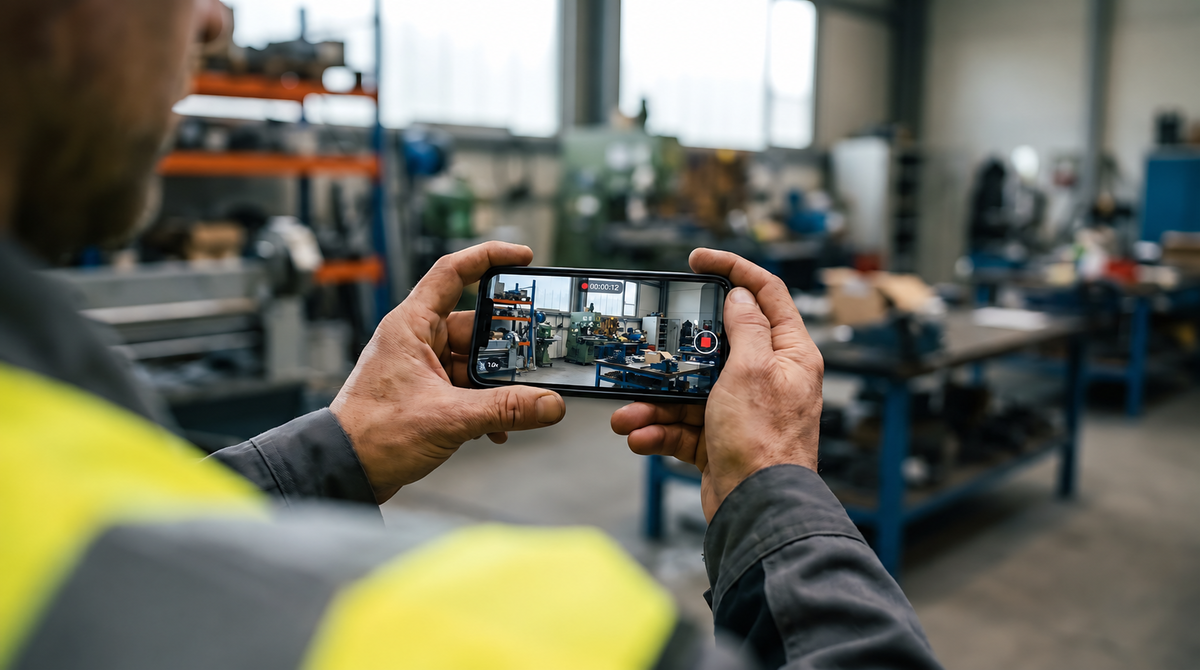
A one- to two-minute tour of your plant, your warehouse, your lab, or your production floor. This is the single most effective video an industrial company can produce because it answers the unspoken question every buyer has: Is this a real operation? Let your plant manager or production lead walk through the space, point out key equipment, and explain what makes your setup different. Shoot it on a phone. Keep it steady. Add captions. Done.
The 60-Second Explainer
Pick one product, one capability, or one service. Explain what it does and who it is for in 60 seconds or less. This format is tailor-made for LinkedIn, where short clips between 30 and 90 seconds perform best for discovery according to current algorithm data. Native LinkedIn video now generates up to two times more engagement than text-only posts, and video creation on the platform is growing 2x faster than any other format.
The Customer Question Video
Take the 10 most common questions your sales team hears. Record your best subject matter expert answering each one, straight to camera, in plain language. These become website FAQ content, social posts, email assets, and — critically — content that AI answer engines can reference. Each video also becomes a blog post when you transcribe it and publish the text alongside the embed.
The Application Case Study
Show the problem, show the solution, show the result. If your customer will let you film on-site, you have gold. If not, B-roll of your production process paired with a voiceover telling the story works nearly as well. This format is especially powerful for distributors and integrators who solve configuration and sourcing problems that are hard to explain in text.
The Expert Perspective
Your CEO, your chief engineer, your VP of sales — whoever has the deepest expertise — speaking for two to three minutes about a trend, a challenge, or a change in the industry. This is pure thought leadership, and it does something no other format can: it puts a human face on your company. For companies that sell expertise as much as products, this video type builds trust at scale.
Where Industrial Video Actually Performs
Not every platform matters for B2B industrial companies. Here is where to focus:
Your Website
This is the highest-impact placement. A video on your homepage, your capabilities page, or your product pages directly influences whether a visitor becomes a lead. Pages with embedded video keep visitors on-site 88% longer, according to Forbes and Vidyard. As we discussed in our recent article on AI agents and the industrial buying process, the content on your website is increasingly evaluated not just by humans but by AI tools researching vendors on behalf of procurement teams. Video content with proper metadata, transcripts, and structured markup feeds both audiences.
LinkedIn is the platform for B2B industrial companies. Period. The platform rolled out a TikTok-style short-form video feed in 2025, and video views grew 36% year-over-year. But here is the most important nuance: video posted from personal profiles outperforms video posted from company pages. If your CEO or sales leader posts a 60-second video sharing a genuine insight, it will reach more people than a polished corporate video on the company page. Authenticity wins on LinkedIn in 2026.
YouTube
YouTube remains the most widely used video platform among marketers at 82%, and the highest-rated for effectiveness at 69%, according to Wyzowl. For industrial companies, YouTube serves as a long-form library. Product demos, installation guides, troubleshooting walkthroughs, and webinar recordings all live here. The SEO value is significant — YouTube is the second-largest search engine, and a well-titled, well-described video can rank for technical queries that your website alone may not.
You do not embed video directly in email — most email clients do not support playback. Instead, include a video thumbnail with a play button that links to the video on your website or YouTube. Email with a video thumbnail sees 200% to 300% higher click-through rates compared to emails without, according to HubSpot. For your next product launch, newsletter, or nurture sequence, a video thumbnail is one of the simplest upgrades you can make. (Related: Marketing Automation + CRM Integration)
A 90-Day Video Playbook for Industrial Companies
We recommend a phased approach. Do not try to become a video production house overnight. Start with what is achievable, measure the results, and expand from there.
Foundation
Choose one video type from the list above. Write a simple script or talking-point outline. Film it on a smartphone with decent lighting and a quiet environment. Add captions and a title card with a free or low-cost editing tool. Publish it on LinkedIn (from a personal profile), embed it on a relevant page of your website, and promote it in your next email.
Build the Library
Produce two to three more videos and vary the type: if you started with a facility walkthrough, add a customer question video and an expert perspective. Transcribe each video and publish the transcript as companion blog content — this doubles the SEO and AI visibility value of every video. Upload the library to YouTube with proper titles, descriptions, and tags.
Measure and Expand
Review the data. Which video drove the most LinkedIn engagement? Which website page saw increased time on site or conversion? Use that to inform next quarter’s plan, and if one format clearly outperformed, do more of it. This is the same data-driven approach we apply in our Amplify Analyze platform — let the numbers guide the investment.
The Connection Between Video and AI Visibility
If you have been following The Industrial Edge or reading our recent articles on measuring AEO and GEO visibility and the AI marketing stack for industrial companies, you know that AI-powered answer engines are reshaping how buyers discover suppliers. Here is the piece that most companies miss: video, done right, is one of the most powerful inputs for AI visibility.
When you produce a video with a descriptive title, a detailed transcript, proper schema markup, and a companion blog post that answers a specific buyer question, you are feeding AI engines exactly what they need to cite your company as an authority. A video titled “How to Select the Right Heat Exchanger for Food Processing Applications” with a full transcript is far more likely to surface in an AI-generated recommendation than a brochure PDF buried three clicks deep on your site.
The investments compound. Accessibility improvements like captions and transcripts serve ADA compliance. The same content serves AI discoverability. The same content serves human buyers who prefer to watch rather than read — one piece of content, working in three directions at once.
Bottom Line
Video has reached the point where not having it creates a visible gap in your marketing presence. Your buyers are watching video as part of their purchase research. Your competitors are starting to produce it. The platforms where your audience spends time — LinkedIn, YouTube, and increasingly AI-powered answer engines — all reward video content with greater visibility and engagement.
The barrier is not budget. The barrier is not equipment. The barrier is starting. Companies that start now will have a compounding advantage over those that wait another year.
You do not need a production studio. You need a phone, a subject matter expert, and five questions your best customers asked before they became customers. Start there.
Ready to put video to work for your industrial company?
Whether you need help developing a video content strategy, integrating video into your website and marketing automation, or connecting it to a broader visibility optimization plan, our team has been doing this for 30+ years.